

In short:
- VIN stands for Vehicle Identification Number — a 17-character code set by the manufacturer under the ISO 3779 standard.
- It's built from three sections: WMI (manufacturer), VDS (vehicle features) and VIS (year, plant, serial number).
- You'll find it on the dashboard, the driver's door jamb, the engine bay — and on your registration, insurance and title documents.
- A VIN lets you check the vehicle's technical data for free. Mileage, damage and theft records live in separate databases and need a vehicle history report.
- The VIN doesn't replace an inspection or test drive — it's one of the checks you do before you commit.
Check a vehicle's history by VIN
What does VIN mean?
VIN stands for Vehicle Identification Number — a unique 17-character code of letters and digits that a manufacturer assigns to a single vehicle. No two vehicles share the same VIN. The format is standardized worldwide under ISO 3779, so a VIN identifies the same way whether the car was built in Germany, Japan or the US. It's used to register a vehicle, insure it, service it and — importantly for a buyer — to look up its history.
How is a VIN built: WMI, VDS and VIS
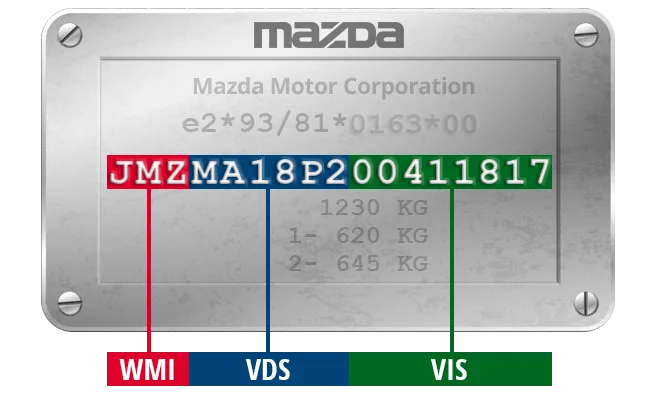
A VIN isn't a random string. It's split into three sections, each doing a different job:
| Section | Position | What it tells you |
|---|---|---|
| WMI — World Manufacturer Identifier | 1–3 | Country/region of origin and the manufacturer |
| VDS — Vehicle Descriptor Section | 4–9 | Model, body type, engine and other features the manufacturer chooses to encode |
| VIS — Vehicle Identifier Section | 10–17 | Model year, assembly plant and the vehicle's serial number |
The first three characters (WMI) are the most standardized part — they're assigned by ISO 3780 and always point to a specific manufacturer. The rest of the VIN follows the general ISO structure, but the exact meaning of each character depends on that manufacturer's own coding scheme, the model and the year.
What each position usually encodes
| Position | Section | Typically encodes | Standardized or manufacturer-specific |
|---|---|---|---|
| 1 | WMI | Country/region | Standardized (ISO 3780) |
| 2 | WMI | Manufacturer | Standardized (ISO 3780) |
| 3 | WMI | Manufacturer division / vehicle category | Standardized, with some manufacturer leeway |
| 4–8 | VDS | Body type, engine, trim, safety systems | Manufacturer-specific, within ISO 3779 |
| 9 | VDS | Check digit (US) or a manufacturer-assigned character | Mandatory in the US; often not used elsewhere |
| 10 | VIS | Model year | Standardized coding, but the cycle repeats every ~30 years |
| 11 | VIS | Assembly plant | Manufacturer-specific |
| 12–17 | VIS | Serial number | Manufacturer-specific, always unique |
The letters I, O and Q never appear in a VIN — they're excluded so they can't be confused with the digits 1 and 0.
The check digit — and why not every VIN has one
Position 9 has a special role in the US and Canada: it's a check digit, calculated from every other character in the VIN using a weighted formula and a remainder-of-11 check (a remainder of 10 is shown as "X"). It exists purely to catch typos — if the check digit doesn't match, the VIN was probably mistyped or altered.
Outside North America, this position often isn't a check digit at all — ISO 3779 doesn't require one. That's normal: a European VIN without a working check digit isn't necessarily wrong, it's just built to a different regional rule.
Where to find the VIN on your vehicle
The VIN is stamped or printed in several places, so you can cross-check it without pulling anything apart:
- Dashboard, driver's side — visible through the windshield from outside the car
- Driver's door jamb — usually on a sticker, along with tyre and weight data
- Engine bay — on a plate near the front of the engine compartment
- Under the vehicle — stamped into the floor pan, firewall or chassis rail on many models
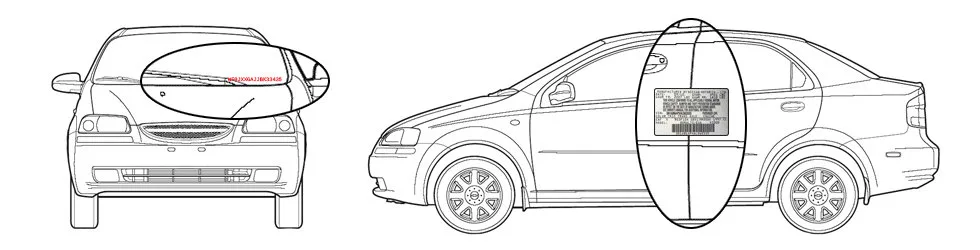
You'll also find the same VIN printed on the registration document, the insurance card, the title and — for EU vehicles — the Certificate of Conformity. All of these should show the exact same number. If they don't, that's a question worth asking before you go any further.
Is a VIN the same as a chassis number?
In practice, yes, on most vehicles sold today — "chassis number" is simply an older term for the same 17-character identifier. On some older or specialist vehicles, a separate manufacturer's chassis or frame number may exist alongside the VIN, but for buying and registering a modern used car, VIN and chassis number refer to the same code.
What a VIN can tell you — and what it can't
This is the part that trips people up. The 17 characters themselves only encode technical information: manufacturer, model, body type, engine and, depending on the maker, trim and equipment. A free VIN decoder reads exactly that — nothing more.
Mileage readings, accident and insurance-damage records, theft reports and title status (like Salvage, Junk or Rebuilt in the US) are not stored in the VIN. They live in separate registries, insurers' databases and service records — the VIN is just the key used to look them up. That's why a VIN number lookup and a full vehicle history report are two different steps, not the same thing.
Why checking the VIN matters before you buy a used car
Before you drive out to view a car, checking its VIN takes a few minutes and can save you a wasted trip:
- Confirm the listing matches the car. The VIN should decode to the same model, engine and body type the seller advertised.
- Compare the VIN in several places. The number on the dashboard, the door jamb and the documents should all match — a mismatch is worth asking about, not necessarily a dealbreaker.
- Look up the available history. A vehicle history report can help you check mileage records, reported damage and, for imports, US title status.
- Treat a refused VIN as a signal. A seller who won't share the VIN, especially on a car priced below market, is worth extra caution.
None of this replaces seeing the car, a test drive or a mechanic's inspection — it's the check you do first, so you know what to look at when you get there.
Check the available data behind a VIN
Common VIN myths, corrected
"Any 17-character code is a valid VIN."
Length is only the first filter. A genuine VIN also has to match a real, assigned manufacturer code and — in the US — a correct check digit.
"The 10th character always tells you the exact production year."
It usually points to the model year, but the code cycles roughly every 30 years and can differ by market. You often need the manufacturer and model range to read it correctly.
"If a report shows no damage, the car was never damaged."
No data just means nothing was found in the databases that were checked. It's not proof of a clean history — compare it with the documents and the car itself.
"A VIN and a chassis number are always two different things."
On modern vehicles they're the same code. The distinction mostly matters for older or specialist vehicles.
"A free VIN decoder shows the same thing as a vehicle history report."
A decoder reads technical specifications. A history report adds mileage, damage, theft and title data from external sources — the two answer different questions.
FAQ
What does VIN stand for?
Vehicle Identification Number — the 17-character code a manufacturer assigns to identify one specific vehicle.
How do I find my car's VIN number?
Check the driver's side dashboard through the windshield, the door jamb sticker, the engine bay, or your registration and insurance documents.
What information can I get from a VIN?
Directly from the VIN or a decoder: manufacturer, model, body type, engine and, depending on the brand, trim level. Mileage, damage and theft records require a vehicle history report.
What does each digit in the VIN mean?
It depends on where the digit sits. The first three characters (WMI) point to the country and manufacturer and follow a fixed ISO 3780 standard. The middle section (VDS, positions 4–9) encodes model, body type and engine, chosen by the manufacturer. The last eight (VIS, positions 10–17) cover model year, assembly plant and a unique serial number. See the position table above for the full breakdown — in the US, position 9 is also a check digit used to catch typos.
Do motorcycles and trailers have a VIN?
Yes. ISO 3779 covers motor vehicles, motorcycles, mopeds and trailers, not just cars.
Why won't a seller give me the VIN?
There's no good reason to withhold it before a viewing. Treat a refusal as a reason to ask more questions, especially if the price looks too good.
Is checking the VIN enough before buying a used car?
It's a strong first step, not the whole process. Combine it with the vehicle's documents, a physical inspection and, ideally, a test drive before you decide.
Key takeaways
A VIN is a standardized, 17-character identifier — not a random number, and not a shortcut to a car's entire history. Reading it correctly tells you what the vehicle is; checking its history tells you what's happened to it. Doing both, alongside a proper inspection, is what actually lowers your risk when buying used.